Bilateral Energy Partnerships
Annual Report 2025

Securing energy together.
Katherina Reiche
Federal Minister for Economic Affairs and Energy
Welcoming words

A successful energy policy requires a trusting cooperation across national borders. Germany builds on the constructive dialogue with its partner countries.
Dear readers,
Successful energy policy depends on cooperation across national borders that is grounded in mutual trust. Whether through energy innovation, shared interests in secure and reliable energy supplies, or business partnerships, Germany’s cooperation with its partner countries is built on trust.
As a foundation of economic activity, social stability and growth, a secure and resilient energy supply continued to play a crucial role in 2025. Among other initiatives, the German–Canadian partnership supported the development of a transatlantic hydrogen bridge. This strengthened energy security in Germany while also opening up new markets. As part of the German–Israeli partnership, experts from both sides discussed how to better protect the electricity system against cyber threats, as well as how the construction of gas storage facilities could increase energy system flexibility. To support Ukraine, we established a dedicated task force under the Energy Partnership.
The Energy Partnerships demonstrate what shared responsibility and common values can achieve. Sustainable energy supply thereby becomes a global collective endeavour and an economic success story.
This annual report offers insights into the approaches and activities undertaken in our partner countries. It takes readers on an engaging journey through the many successes of our bilateral cooperation.
I hope you enjoy reading our annual report.

Resilient energy systems for people and markets
Energy Security
Reliable and affordable energy is the foundation for resilience and growth. Working closely with our partners, we are building a sustainable energy future.
You are currently viewing a placeholder content from Vimeo. To access the actual content, click the button below. Please note that doing so will share data with third-party providers.
More InformationEnergy security today: a scholarly analysis
Dr Cyril Stephanos, an independent researcher at the German Academy of Science and Engineering, introduces us to the topic of energy security.
A Reliable Energy Supply and a Crisis-Proof Energy System Cannot Be Taken for Granted
“A secure and reliable energy supply is not only a priority for Germany. Germany’s partner countries must also navigate geopolitical risks and uncertain supply chains and ensure their own energy supply. That is why the Energy Partnerships focus on strengthening energy systems both in Germany and in partner countries, and on diversifying energy generation. The principle here is: more partnerships mean less dependence. Only when energy is sourced from a variety of sources is the supply truly resilient.”
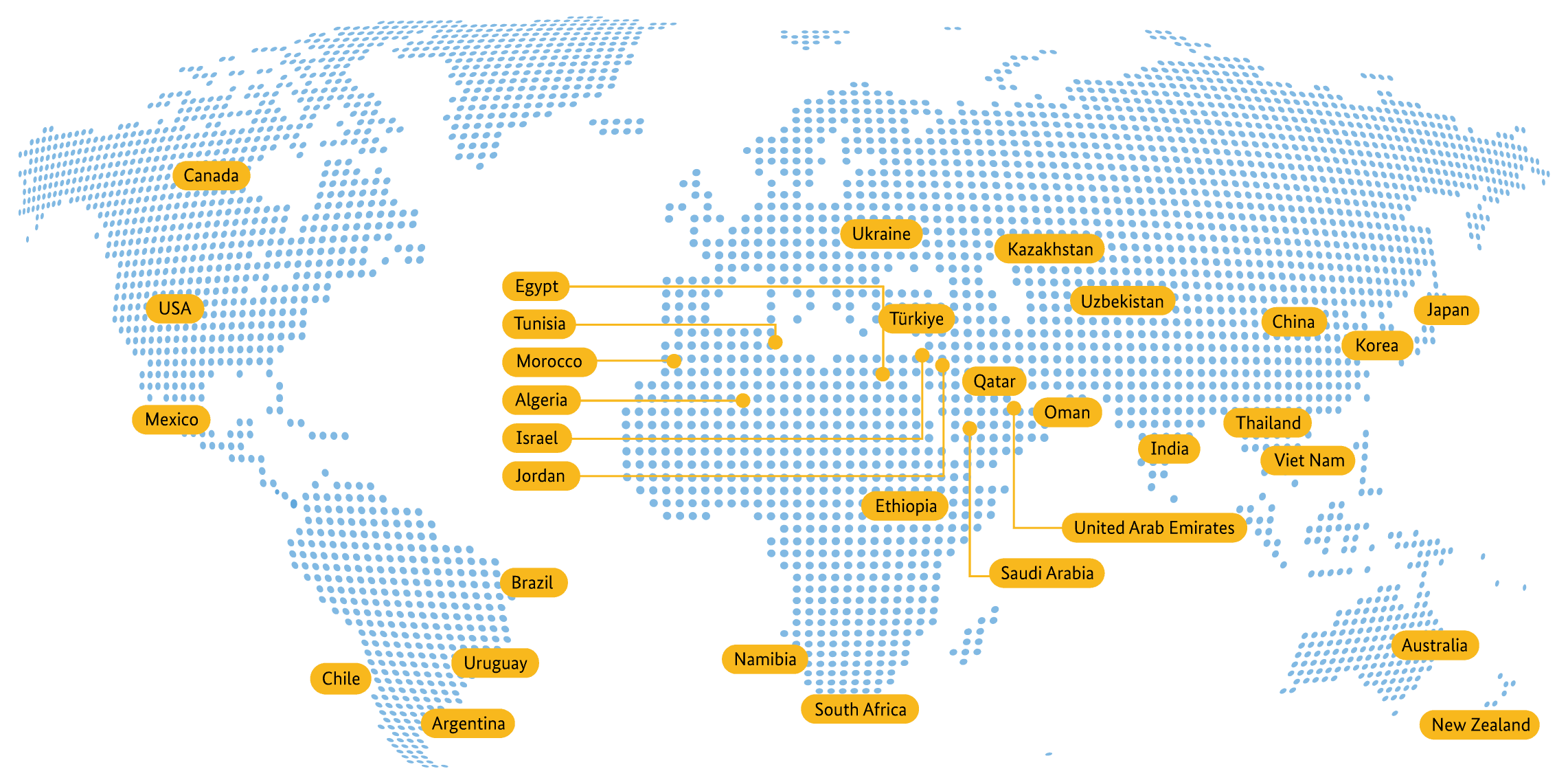
32 partnerships around the world
Three objectives
These partnerships are built on long-standing trust and successful collaboration. They enhance cooperation on climate action, accelerate the expansion of renewable energy and improvements in energy efficiency, and help the partners achieve their climate targets.
Energy Security
Energy security is global team work.
Decarbonisation
Renewable Energy is our shared value.

Foreign Trade Promotion
Climate-friendly innovation drives sustainable growth.
What were our best moments in 2025?
Algeria
In 2025, the Algerian-German Energy Partnership celebrated 10 years of cooperationIn 2025, the German-Algerian Energy Partnership celebrated 10 years of cooperationIn 2025, the German-Algerian Energy Partnership celebrated 10 years of cooperation
Australia
The partnership brought together more than 200 participants from Australia and the European Union at the Australia-EU Hydrogen Supply Chain Forum in Perth.
Chile
Publication of a policy brief handbook on agri-photovoltaics, a combination of agriculture and energy generation, to support the regulatory, technical and social framework and on-the-ground implementation.
Ethiopia
In-depth training sessions on PtX hydrogen value chains for sustainable aviation fuel (eSAF) and the simultaneous establishment of the Ethiopian Hydrogen Association (EHA).
India
A particular highlight was the joint German pavilion at Windergy India, one of the country’s leading wind energy conferences. More than 15 German companies took part in a business-to-government roundtable there.
Israel
The Minister’s visit to Israel and the joint signing of the work program for 2026 with her Israeli colleague Eli Cohen, Minister of Energy and Infrastructure, strengthen bilateral relations and show both countries’ commitment to the Energy Partnership.
Japan
Geothermal energy has been identified as a new area for the energy partnership. This coincides with the publication of a comparative study, an expert workshop and a government-to-government exchange.
Jordan
Collaboration between Jordanian ministries, authorities, international stakeholders, and the private sector in developing a roadmap for a resilient and low-carbon building sector in Jordan at the Roadmap workshop “Challenges and Opportunities”.
Kazakhstan
The activities of the Energy Dialogue for the decarbonisation of the building sector prompted Astana city council to develop its own modernisation plan.
Qatar
In November 2025, during her visit to Doha, Minister Katherina Reiche, together with Minister Al Kaabi, highlighted the potential for deeper economic cooperation in the fields of energy and liquefied natural gas.
Saudi-Arabia
Minister Katherina Reiche’s visit to Riyadh and Jeddah, as well as the signing of a memorandum of understanding on enhanced cooperation on energy matters, are strengthening bilateral relations and the energy dialogue.
Thailand
One highlight was the strengthening of cooperation through the establishment of the Thai-German Energy Dialogue.
Tunisia
The High-Level Tunisian-German Energy Day was a highlight of 2025 and underscored both countries’ determination to further strengthen their partnership.
Türkiye
The study tour in Izmir, Türkiye, connected geothermal and district heating expertise, enabling practical exchange, new partnerships, and ongoing cooperation to advance low-carbon heating solutions.
United Arab Emirates
The visit by Katherina Reiche and the Energy Forum, at which more than 160 representatives from government and industry discussed ways to tackle the growing energy demand generated by data centres and to strengthen the energy infrastructure.
Ukraine
The fundraising campaign for Ukraine’s energy sector has significantly strengthened the country’s energy resilience. Thanks to the delivery of over 34,000 critical energy components, around 1.4 million people in Ukraine have regained access to electricity and heating since the start of the Russian invasion.
Uruguay
The study trip to Berlin on the topic of ‘Energy efficiency in buildings’ and the associated discussion on funding mechanisms and regulatory standards.
USA
The two delegation visits and trade missions from the US to Germany, which were aimed at establishing new business contacts on both sides of the Atlantic.
Uzbekistan
The opening of the Uzbek-German Training Centre for Energy Efficiency and Renewable Energy. It serves as a key hub for developing green skills and supports the energy transition in Uzbekistan by building technical capacity.
Viet Nam
One highlight was the development of the existing energy dialogue into an energy partnership, with the aim of promoting private investment in a sustainable, affordable and resilient energy system.