Since 2019
Deepening Hydrogen Cooperation and Unlocking Geothermal Potential
- Japan and Germany share similar challenges in becoming large-scale hydrogen importers. This drove bilateral cooperation along the hydrogen value chain in 2025.
- The Partnership provided workshops for practical exchange on hydrogen, covering port infrastructure, import readiness, financing models, investment risks and regulatory barriers.
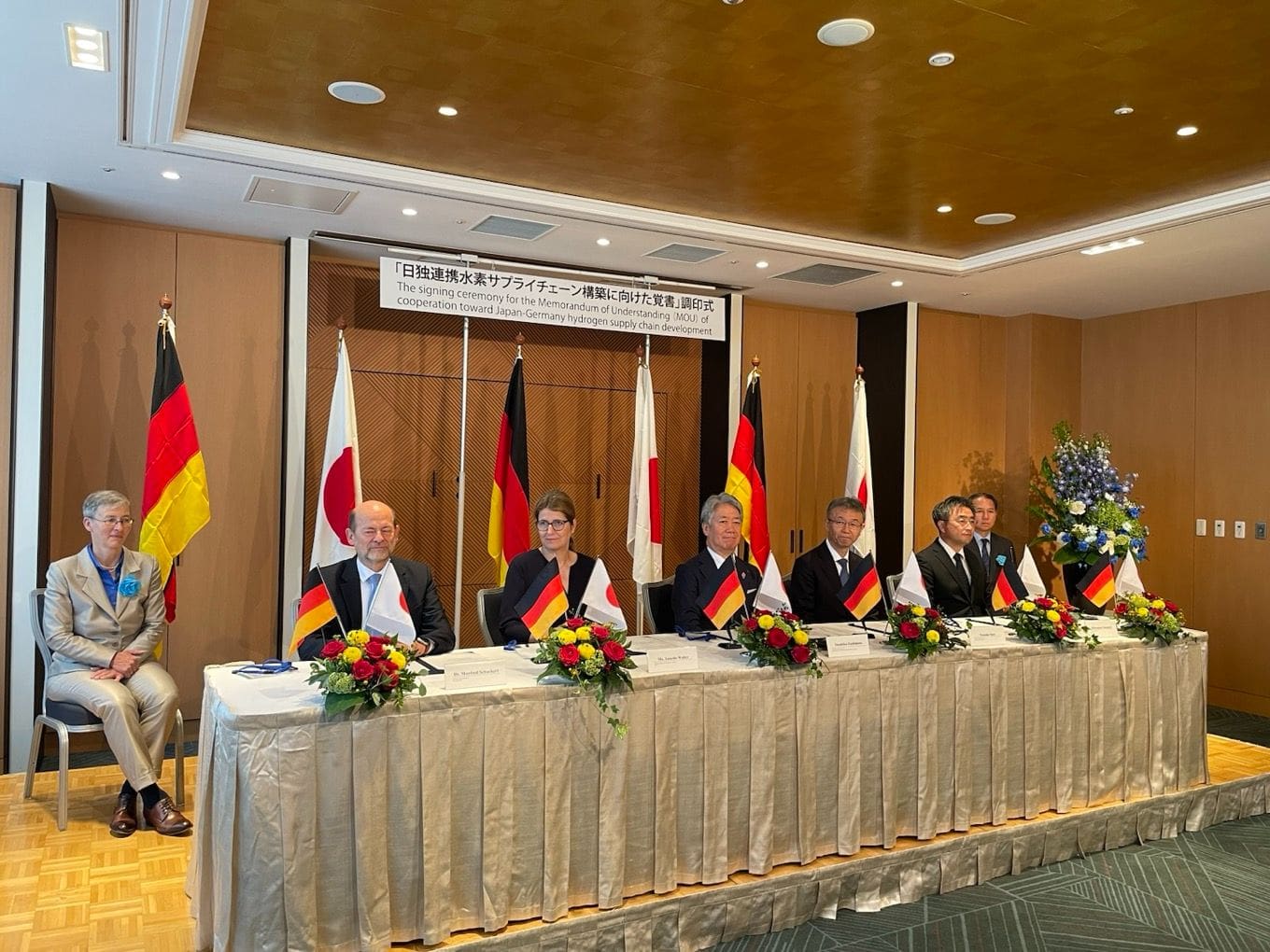
- A new line of technical cooperation on hydrogen safety and the support of a Memorandum of Understanding (MoU) on a binational liquid hydrogen supply chain illustrate how the partnership not only facilitates policy dialogue, but also supports technical exchanges and industrial collaboration.
- Geothermal energy emerged as a new field of cooperation, with a comparative study, an expert workshop and a government exchange, laying the groundwork for future bilateral collaboration.
Decarbonisation
Foreign Trade Promotion
Bridging policy and industry on hydrogen
Japan and Germany are both preparing to become large-scale hydrogen importers. In 2025, the Japanese-German Energy Partnership supported close bilateral cooperation in pursuit of this shared strategic objective by facilitating regular exchanges between government officials and industry representatives. Dedicated workshops explored critical topics – from port infrastructure and import readiness to financing models, investment risks, and regulatory barriers in hydrogen project implementation. Towards the end of the year, the Partnership also established a new area of technical cooperation on hydrogen safety, with a kick-off workshop bringing together specialised institutes from both countries. Additionally, the partnership strengthened industrial ties by supporting the signing of a Memorandum of Understanding (MoU) between five leading Japanese and German companies, establishing a binational liquid hydrogen supply chain in September 2025.
New cooperation on geothermal energy
With both Germany and Japan holding large untapped geothermal resources, the partnership identified strong potential for bilateral cooperation in this sector. To lay the groundwork, the Energy Partnership (EP) team conducted a comparative study of geological conditions, policy frameworks and economic potential in both countries. The study revealed that although the two countries differ significantly in their subsurface characteristics and priorities for geothermal use, they share many of the same challenges. In November, an expert workshop brought together specialists from research, government and industry to explore innovative approaches and define the fields where bilateral learning can be most impactful – such as measurement technologies and seasonal storage solutions. Additionally, a government exchange supported Japan’s efforts to develop a legal framework for geothermal energy.
Why do we need more women in the energy sector?
Take a look into the video of the “Women in Leadership in the Energy Sector” event at the German Embassy in Tokyo.
You are currently viewing a placeholder content from Vimeo. To access the actual content, click the button below. Please note that doing so will share data with third-party providers.
More InformationMore information
1. What has been the most tangible outcome or impact of your partnership activities in 2025?
Through its working group on hydrogen and other dedicated formats, the Japanese-German Energy Partnership contributed to building international hydrogen supply chains and strengthened the position of German companies in the global hydrogen economy.
As a tangible example from 2025, the partnership proved an effective platform for political facilitation, enabling the high-level participation of the Federal Ministry of Economic Affairs and Energy (BMWE) at the signing ceremony of a Memorandum of Understanding (MoU) between five leading companies from both countries and facilitating in-depth exchanges between company representatives and the German government delegation in September. Kawasaki Heavy Industries, Toyota Motor Corporation and Kansai Electric Power on the Japanese side, and Daimler Truck and HHLA Hamburger Hafen und Logistik AG on the German side plan to jointly establish a binational LH2 supply chain. The initiative draws on Japanese LH2 expertise and positions Hamburg as a potential European LH2 import hub.
2. Which focus areas were particularly relevant for your country in 2025 and why?
- Hydrogen: In 2025, hydrogen remained at the core of the cooperation. As Germany and Japan moved from demonstration projects towards large-scale deployment, the focus shifted more strongly to enabling conditions for rollout, including hydrogen safety, infrastructure build‑up and persistent financing barriers linked to regulatory uncertainty, evolving certification schemes and long project lead times.
- Geothermal Energy: In 2025, geothermal energy was established as a new field of cooperation. Despite their distinct geological characteristics, both Japan and Germany possess considerable untapped geothermal resources whose utilisation could strengthen sustainable, resilient energy systems and accelerate progress towards carbon neutrality. Moreover, in Japan, there is currently significant political momentum around geothermal energy, in particular the advancement of next‑generation geothermal technologies, which offers a window of opportunity for deepening bilateral collaboration.
- Offshore Wind: Amid market uncertainty and ongoing reforms in Japan’s offshore wind sector, the partnership team particularly focused on representing and supporting German industry interests in the Japanese market. The parnership established formats such as industry roundtables, as well as targeted contributions at high‑level events and trade fairs, to consolidate German companies’ concerns – in particular on auction design – and channel them into exchanges with the partner ministry.
3. How did your activities contribute to the selected overarching goals (energy security, decarbonisation, foreign trade promotion)?
Foreign Trade Promotion
The Japanese-German Energy Partnership continuously represented the interests of German companies in Japan’s energy market. Workshops, industry roundtables and trade fairs provided German companies with a platform to present themselves, offer networking opportunities with Japanese partners, and enable direct exchanges with the ministry to raise concerns and explore solutions. In particular in the offshore wind sector, industry concerns regarding auction design were consolidated through established formats and channelled into dialogue with the partner ministry.
Decarbonisation
The partnership advanced decarbonisation across a broad range of topics. The two Working Groups on Energy Transition and Hydrogen, convened meetings and activities throughout 2025, serving as a central platform for interministerial exchange and facilitating expert discussions on decarbonisation strategies, including key aspects of the hydrogen transition. It further broadened its decarbonisation agenda by developing dedicated knowledge products such as the study on geothermal energy in Germany and Japan.
Energy Security
The partnership also contributed to strengthening energy security. By facilitating exchanges on hydrogen infrastructure and port readiness, and by supporting the Japanese–German liquid hydrogen supply chain cooperation, it helped advance the diversification of future energy import pathways and deepen Japanese–Germany linkages in emerging global hydrogen trade.
4. What concrete activities are planned for 2026?
An expert event on the Japanese-German hydrogen cooperation is planned in Tokyo, with the topic: “From Research to Market: Strengthening Hydrogen Cooperation between Germany and Japan”, for March 2026.